There Is No Non-Blind Taqlid
In various texts, articles, and discussions, people use the phrase "blind taqlid" and claim that taqlid can be either blind or non-blind, considering only the blind form as undesirable. This section will show that such phrases are meaningless and merely a play on words.
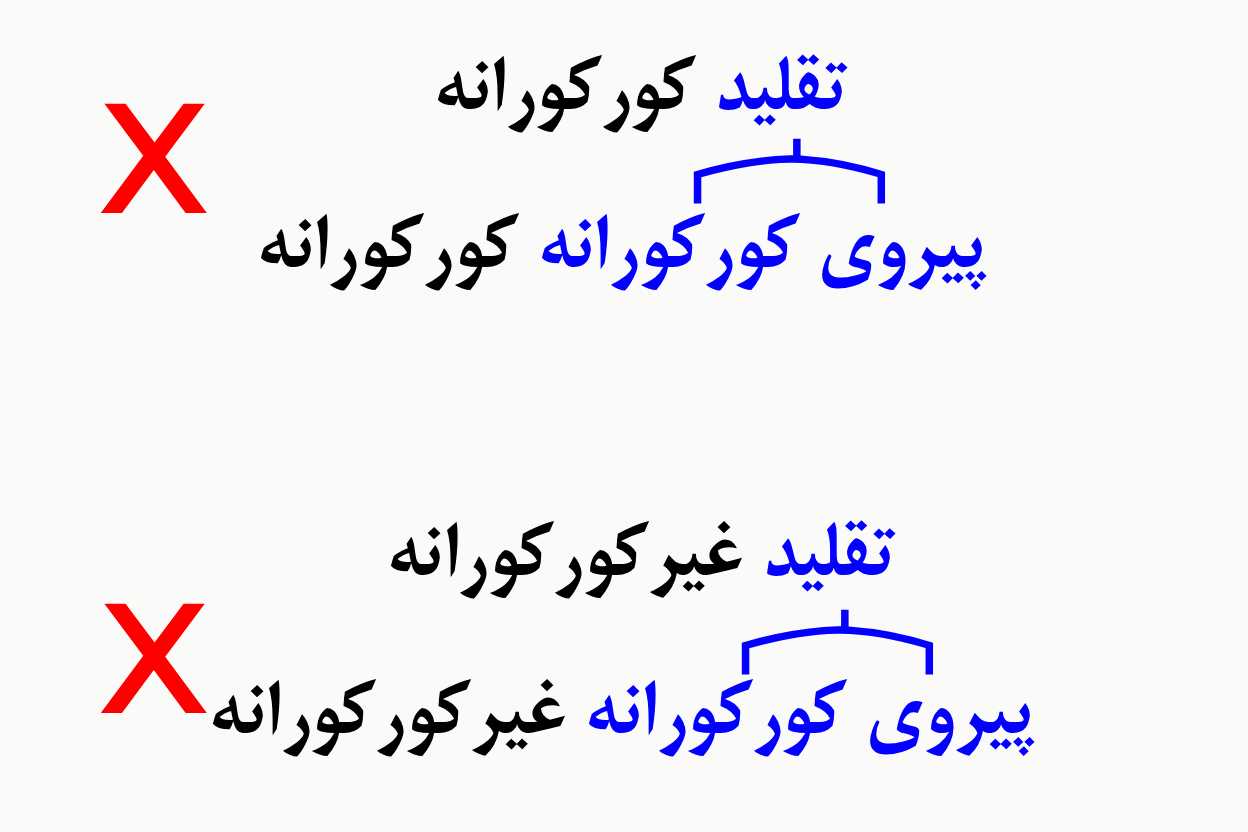
Blindness is part of the definition of taqlid
According to the definition presented in "Literal and Technical Definition," taqlid means "following without knowledge and without asking for evidence," and according to Ayatollah Sistani's definition in the same section, it means following without insight — which in Persian is expressed as "with eyes (and ears) closed," i.e., "blindly." Therefore, if we accept that taqlid itself means "blind following," then the phrase "blind taqlid" would mean "blind blind following," which is redundant and unnecessary. Likewise, "non-blind taqlid" would mean "non-blind blind following," which is self-contradictory and completely meaningless.
Examples of this wordplay are reviewed below. The first example is in the Persian translation of Al-Mizan commentary. While Allamah Tabatabai in the original Arabic text uses only the word taqlid, the translators added the word "blind" themselves:
"And the command to mention this blessing is based on what is the custom of the Qur'an — that it places its teaching on the explanation of causes and reasons, and calls to goodness and guidance from its proper perspective, without commanding common blind taqlid..." (Source)
The Persian translation adds the word "blind" where the original Arabic says al-taqlid al-ammi al-mu'amma (common obscure imitation), but the translators rendered it as "blind taqlid."
A second example also from the translation of Al-Mizan: while discussing verses 16-25 of Surah al-Zukhruf, the word taqlid is used, and again the translator uses the phrase "blind taqlid."
Generally, a thorough investigation of this issue in the translation of Al-Mizan requires a separate detailed study. A search for the word "taqlid" in the Arabic text of Al-Mizan (here) yields 127 results, and a cursory look suggests that Allamah did not use an Arabic word meaning "blind" after taqlid. Meanwhile, in the Persian text, the phrase "blind taqlid" appears nearly 20 times (here).
Other examples of this fabricated and meaningless phrase are given below:
- In his commentary on verse 104 of Surah al-Ma'idah, Qara'ati writes: "Blind taqlid is a sign of foolishness."
- Makarem Shirazi writes in the first volume of Payam-e Qur'an: "Blind taqlid — or in other words, the imitation of an ignorant person from another ignorant person, and worse still, the imitation of a scholar from an ignorant person — is a sign of intellectual dependency..."
Deliberate choice of marja' does not solve the blindness problem
It seems this phrase entered the lexicon of some contemporaries because they assumed the criterion for being blind or non-blind is the correct selection of the marja'. That is, if someone chooses their marja' with open eyes and then accepts whatever he says, it is no longer blind. The third example illustrates this better:
"Improper taqlid means following someone who himself does not understand, and there are many verses in the Qur'an that strongly prohibit this. Here I should mention an important point: the taqlid that is said to be obligatory in fiqh means that a person who lacks skill should refer to those who have skill and knowledge and ask them — just as when we get sick and don't know what illness we have, we go to a doctor, or we go to a barber for a haircut, or entrust a shirt to a tailor and a building to an architect. So we ask a religious scholar about religious matters in the same way. Thus, obligatory taqlid is referring to an expert, and forbidden taqlid is the blind kind. Another name for blind taqlid is 'fashion' — we don't know the reason for something and are content with it being fashionable." (Source)
As can be seen, they consider the deliberate and open-eyed selection of the marja' as a condition for taqlid not being blind. To show the incorrectness of this condition, we must note that the act of taqlid has three parts: the subject (the obligated person), the object (the marja'), and the act itself (the act of imitation). Clearly, the word taqlid describes the act of following itself and has nothing to do with the selection of the marja', which is a separate act performed beforehand. In other words, if someone is searching for a marja' with open eyes and ears, and we ask them what they are doing, they would not say "I am imitating" — so we could say their imitation is non-blind. But once they have chosen their marja', even assuming they have chosen the best possible marja', when they follow him without asking for evidence, this act of following is blind.
To put it differently, even if someone directly reaches the presence of the Prophet (pbuh) or even somehow directly reaches the presence of God and follows their commands without asking for evidence or reflection — though they have chosen the most luminous source with very open and careful eyes — ultimately, the act they perform is blind following, and we call this act taqlid of the Prophet (pbuh) and God. The message of this collection of writings is that taqlid even of the Prophet (pbuh) and God is bad and harmful. This is somewhat like a student saying, "Only cheating without thinking is bad! But if someone uses their mind to find the student who will be top of the class at the end of the year and cheats from him, then it's fine — it's rational cheating!" In the same vein, my point is that no — cheating inherently involves setting aside thought, and there is no such thing as "thoughtful cheating." Even if someone with mental effort finds a way to copy from the teacher, or somehow gains access to the highest educational authority in the country and gets the answers from him, ultimately the answer they give is without thought on the problem and is cheating, and they gain no benefit from it — they have only lost.
Checking halal and haram is also insufficient for non-blindness
Another group takes "non-blind taqlid" to mean that the obligated person always ensures that the marja' does not declare what God has made halal as haram or vice versa. They believe that as long as the person oversees this condition, their taqlid is not blind. This argument is incorrect for several reasons. Theoretically, if we accept that the obligated person cannot distinguish halal from haram and needs to refer without evidence to the marja' for this purpose, then a vicious circle arises — because they cannot oversee whether the marja' has observed God's halal and haram. This problem can also be demonstrated in practice. For example, on the issue of interest-bearing loans, a person who believes in taqlid and does not consider it their duty to engage in tafaqquh (deep understanding) makes no effort to discern God's halal and haram, claiming "I'm not an expert," and cannot offer an opinion on whether the marja' has observed halal and haram.
In response to this argument, it is said that "the obligated person oversees the clear and common generalities shared by all maraji'." But even accepting this, it can be said that those shared generalities lie outside the scope of taqlid — because as long as there is consensus among all maraji', taqlid of a specific individual has no meaning or basis. On the other hand, as soon as disagreement arises, the issue of taqlid comes into play, and that is precisely where it falls outside the scope of the person's oversight. So overall, no oversight takes place, and it remains blind. Put simply, taqlid only occurs in disputed rulings, and it is precisely there that the person cannot distinguish halal from haram — so what they describe as "non-blind taqlid" cannot be carried out.
It is also worth mentioning that the idea of checking halal and haram is rooted in narrations where the Infallible Imam, interpreting the verse that considers taqlid in Judaism and Christianity as shirk (associating partners with God), stated that their taqlid was evil because their scholars made halal what God had made haram and vice versa (see "Taqlid of the Common People from Jurists"). From this, some conclude that Shia taqlid is not evil because Shia scholars do not swap God's halal and haram — and thus this has become an unwritten condition for the authority of a marja'. As explained above, such a condition cannot be verified. Another problem this incorrect understanding creates is that it ties the scholar's hands before the truth. That is, a scholar might genuinely and with evidence conclude that something previously halal is now haram due to changing circumstances, or vice versa — but because of this incorrect understanding, he is forced to maintain the previous position and remain silent. Examples of problems this situation has created have been observed in recent decades in Iran.
Another indication
Another indication confirming that there is no such thing as non-blind taqlid is that when discussing the prohibition of taqlid in beliefs, no one raises the issue of blind versus non-blind and says only blind taqlid is forbidden in beliefs. Thus, as stated, the phrases "blind taqlid" and "non-blind taqlid" are meaningless and merely a kind of wordplay to satisfy the audience's mind. In other words, taqlid can only be non-blind in one case: when the person asks the marja' for evidence and weighs it with open eyes and ears. Of course, in that case, this act is no longer called taqlid, because taqlid and blind following are equivalent — setting aside one means setting aside the other, and acting on one means performing the other.
Parent page: Definition of Taqlid